
Strong Markets Defy Global Unrest: The Three-Legged Stool
May 11, 2026

Brian G. Davies
Vice President and Senior Wealth Advisor
Washington Trust Wealth Management
You may be wondering how the markets can be doing so well when the world can feel like it’s on fire with so much geopolitical unrest. Geopolitical events may drive short-term volatility but historically have had limited long-term impact. Think of it as a three-legged stool: corporate earnings, valuations, and shareholder returns through dividends and buybacks. When those three legs are stable, so is the market.
Corporate Earnings
This is the most critical leg of the stool. At its core, the stock market reflects the profitability and growth of businesses. Right now, earnings growth has been solid, in many cases expanding at a double-digit pace. Companies are continuing to generate revenue, manage costs, and deliver profits. During earnings season, you get a real-time look at how businesses are actually performing, not how they’re perceived. And broadly speaking, that performance has been strong enough to support market gains.
Valuations
Coming into the year, valuations were elevated by historical standards. That alone can make investors uneasy, especially when layered on top of global uncertainty. But geopolitical tensions, while unsettling, have had the side effect of tempering those valuations. Market pullbacks, even modest ones, can bring prices more in line with underlying fundamentals. That doesn’t mean stocks are “cheap” today, but they are more reasonably priced than they were at the start of the year. Some of the excess has been worked off, creating a healthier entry point for long-term investors.
Dividends and Buybacks by Corporations
The third leg is how companies return capital to shareholders. Dividends and stock buybacks provide a steady, tangible benefit. Dividends offer income regardless of market direction, while buybacks reduce the number of shares outstanding, potentially boosting earnings per share over time. Together, they create a supportive undercurrent for stock prices. Historically, this has been a positive force in most market environments. There are exceptions—such as the late 1990s, when a surge of IPO activity diluted that effect—but those are the outliers, not the rule.
The Impact of Geopolitical Events
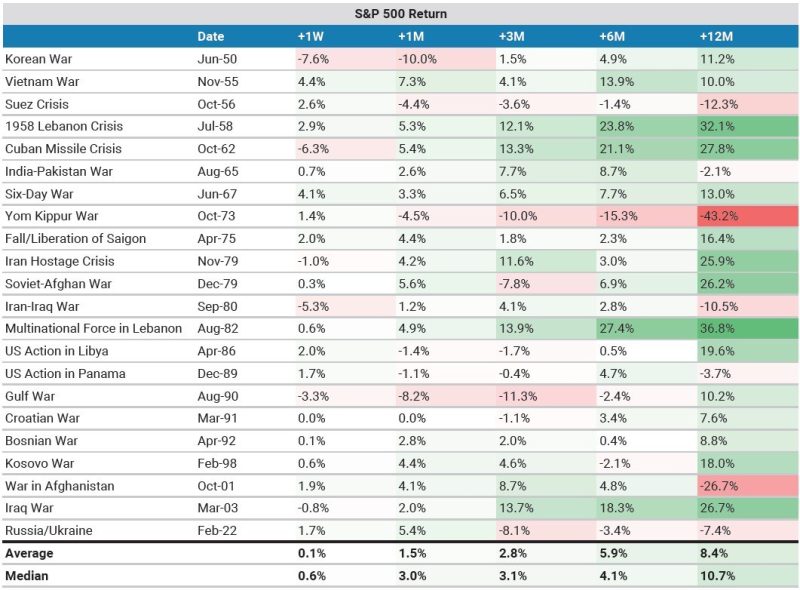
It seems intuitive that major global events should have a lasting negative impact on markets. And in the short term, they often do. You’ll see spikes in volatility, sudden pullbacks, and sharp reactions as investors process new information. But history shows that geopolitical events have short-lived impact on stocks and do not affect long-term performance. Markets are forward looking. They absorb shocks, adjust expectations, and move on.
That doesn’t mean geopolitical events are irrelevant. They can influence energy prices, supply chains, and investor sentiment. They can create uncertainty and, at times, real economic consequences. But over the long term, the market’s direction is driven far more by earnings growth, productivity, and innovation than by any single conflict or crisis.
How this Affects You as an Investor
So where does that leave you as an investor? It means recognizing the difference between noise and signal. The noise is loud right now. But the underlying strength of corporate earnings, more balanced valuations, and consistent shareholder returns remains intact.
The takeaway is not to ignore risk, but to properly frame it. Increased volatility is a natural byproduct of uncertainty, but increased uncertainty doesn’t necessarily translate into poor long-term market performance. In fact, some of the strongest periods for stocks have come during times of elevated concern, precisely because markets had already priced in a degree of risk.
The apparent disconnect between global instability and market performance is not a flaw; it’s a reflection of how markets function. They don’t mirror the present moment; they anticipate what comes next.
Washington Trust Wealth Management Can Make Sense of It All
Having a clear, disciplined strategy matters today more than ever. If you’re trying to make sense of shifting conditions or simply want to ensure your portfolio remains aligned with your goals, risk tolerance, and time horizon, this is a good time to have a conversation with one of our experienced wealth advisors. The team at Washington Trust Wealth Management is here to help you cut through the noise, evaluate your current positioning, and make prudent decisions grounded in long-term fundamentals. Reach out today to start a more focused discussion about where you are and where you want to go.
Connect with a wealth advisor
No matter where you are in life, we can help. Get started with one of our experts today. Contact us at 800-582-1076 or submit an online form.
This document is intended as a broad overview of some of the services provided to certain types of Washington Trust Wealth Management clients. This material is presented solely for informational purposes, and nothing herein constitutes investment, legal, accounting, actuarial or tax advice. It does not take into account any investor's particular investment objectives, strategies, tax status or investment horizon. Please consult with a financial counselor, an attorney or tax professional regarding your specific financial, legal or tax situation. No recommendation or advice is being given in this presentation as to whether any investment or fund is suitable for a particular investor. It should not be assumed that any investments in securities, companies, sectors, or markets identified and described were, or will be, profitable.
Any views or opinions expressed are those of Washington Trust Wealth Management and are subject to change based on product changes, market, and other conditions. All information is current as of the date of this material and is subject to change without notice. This document, and the information contained herein, is not, and does not constitute, a public or retail offer to buy, sell, or hold a security or a public or retail solicitation of an offer to buy, sell, or hold, any fund, units or shares of any fund, security or other instrument, or to participate in any investment strategy, or an offer to render any wealth management services. Past Performance is No Guarantee of Future Results.
It is important to remember that investing entails risk. Stock markets and investments in individual stocks are volatile and can decline significantly in response to issuer, market, economic, political, regulatory, geopolitical, and other conditions. Investments in foreign markets through issuers or currencies can involve greater risk and volatility than U.S. investments because of adverse market, economic, political, regulatory, geopolitical, or other conditions. Emerging markets can have less market structure, depth, and regulatory oversight and greater political, social, and economic instability than developed markets. Fixed Income investments, including floating rate bonds, involve risks such as interest rate risk, credit risk and market risk, including the possible loss of principal. Interest rate risk is the risk that interest rates will rise, causing bond prices to fall. The value of a portfolio will fluctuate based on market conditions and the value of the underlying securities. Diversification does not assure or guarantee better performance and cannot eliminate the risk of investment loss. Investors should contact a tax advisor regarding the suitability of tax-exempt investments in their portfolio.