
The Economy Needs a Productivity Boost. Can AI Deliver?
August 31, 2026

The Economy Needs a Productivity Boost. Can AI Deliver?
Brian Davies, CFA®
Vice President and Senior Wealth Advisor
Washington Trust Wealth Management
Artificial intelligence (AI) has quickly become one of the most debated forces shaping the economic outlook. Will it eliminate millions of jobs, make work optional, or usher in a new era of productivity? Even people “in the know” offer wildly different answers. Some forecast massive white-collar job losses, while others see AI as a transformational technology capable of producing enormous gains in productivity and economic output.
But what if AI’s long-term impact is less about replacing workers and more about replacing missing growth? As labor-force growth slows and populations age, the more consequential question may be whether AI can help fill that widening economic gap.
Drivers of GDP Growth
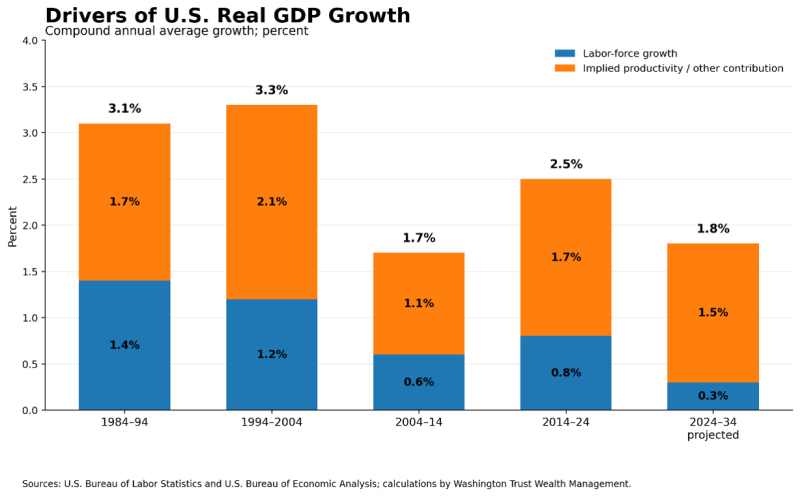
At a high level, GDP growth is driven primarily by two factors: growth in the labor force (number of workers) and growth in productivity (output per worker). For much of the postwar period, the United States benefited from both. The workforce expanded as the population grew, women entered the labor force in greater numbers, and the baby-boom generation moved through its prime working years.
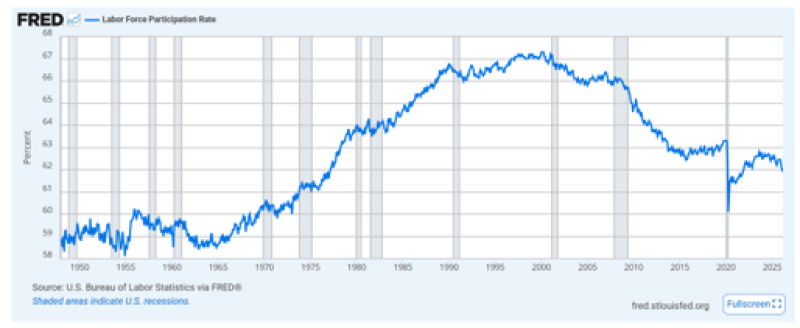
That demographic support is now weaker. U.S. population growth has slowed, the population is aging and more Americans are moving into retirement. The labor-force participation rate reflects that shift. It peaked at 67.3% in 2000 and today stands near 62%.i
While the United States is not running out of workers, labor-force growth is unlikely to contribute as much to future GDP growth as it once did. That leaves productivity to do more of the work.
Technology Creates Winners and Losers
Major technological shifts are often overestimated in the near term and underestimated over the long term. The automobile hurt businesses tied to horses and carriage transportation (think buggy whip manufacturers). Automation displaced many production jobs. Since the 1950s, computers have eliminated some clerical functions while creating new industries and making many workers more productive.
These transitions are not painless. Some workers and industries lost out even as the broader economy benefited. AI is unlikely to be different.
The Productivity Question
The more useful macroeconomic question is not whether AI is simply good or bad for employment. It is whether AI can raise productivity enough to offset slower workforce growth.
AI could help workers produce more through automation, faster analysis and software development, and lower administrative costs. But technological capability does not automatically become economy-wide productivity. Companies must invest, change workflows and determine where AI produces measurable returns. That process could take years, even as the need for higher productivity is becoming more pressing. If labor input contributes less, productivity must contribute more.
This is not a United States problem; it is a global one. Aging populations and lower birth rates are constraining labor-force growth across much of Europe and Japan, while China also faces rapid population aging and population decline.
What Happens Without a Productivity Boost?
The Bureau of Labor Statistics projects labor-force growth of just 0.3% annually from 2024 through 2034, alongside real GDP growth of 1.8%.
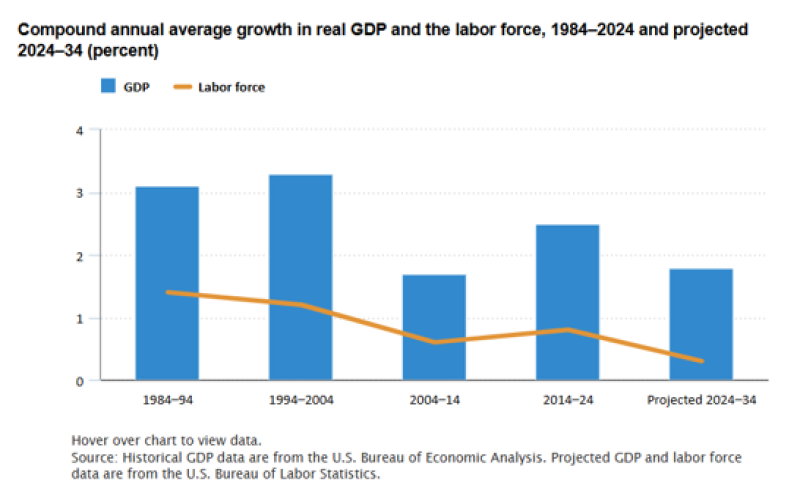
That projection underscores how much future growth will depend on productivity. If productivity growth fails to compensate for weaker labor-force growth, the economy’s sustainable growth rate could fall further, unable to sustain the roughly 2% real GDP growth to which Americans have become accustomed. If the structural growth rate moved closer to 1%, it would have serious implications for corporate earnings, government finances, investment returns, and living standards.
So the question is: Can AI generate enough sustained productivity growth to compensate for a workforce that is no longer expanding at the pace it once did?
It may deliver. It may fall short of current expectations. And the gains may take longer to appear—or be distributed less evenly—than AI's strongest advocates expect. While no one knows for certain, we do believe that this technology, overall, will have a positive long-term economic impact. And one thing we do know for certain: the demographic challenge makes the question increasingly difficult to ignore.
Washington Trust Wealth Management Can Help
We know the headlines around AI can be confusing and unsettling. As artificial intelligence, demographic shifts, and changing productivity trends reshape the economic landscape, the experienced advisors at Washington Trust can help you make sense of how these forces could affect your portfolio and long-term growth. Looking closely at your specific goals, time horizon, and risk tolerance, we can work with you to determine the best course for your investment strategy.
Connect with a wealth advisor
No matter where you are in life, we can help. Get started with one of our experts today. Contact us at 800-582-1076 or submit an online form.
This document is intended as a broad overview of some of the services provided to certain types of Washington Trust Wealth Management clients. This material is presented solely for informational purposes, and nothing herein constitutes investment, legal, accounting, actuarial or tax advice. It does not take into account any investor's particular investment objectives, strategies, tax status or investment horizon. Please consult with a financial counselor, an attorney or tax professional regarding your specific financial, legal or tax situation. No recommendation or advice is being given in this presentation as to whether any investment or fund is suitable for a particular investor. It should not be assumed that any investments in securities, companies, sectors, or markets identified and described were, or will be, profitable.
Any views or opinions expressed are those of Washington Trust Wealth Management and are subject to change based on product changes, market, and other conditions. All information is current as of the date of this material and is subject to change without notice. This document, and the information contained herein, is not, and does not constitute, a public or retail offer to buy, sell, or hold a security or a public or retail solicitation of an offer to buy, sell, or hold, any fund, units or shares of any fund, security or other instrument, or to participate in any investment strategy, or an offer to render any wealth management services. Past Performance is No Guarantee of Future Results.
It is important to remember that investing entails risk. Stock markets and investments in individual stocks are volatile and can decline significantly in response to issuer, market, economic, political, regulatory, geopolitical, and other conditions. Investments in foreign markets through issuers or currencies can involve greater risk and volatility than U.S. investments because of adverse market, economic, political, regulatory, geopolitical, or other conditions. Emerging markets can have less market structure, depth, and regulatory oversight and greater political, social, and economic instability than developed markets. Fixed Income investments, including floating rate bonds, involve risks such as interest rate risk, credit risk and market risk, including the possible loss of principal. Interest rate risk is the risk that interest rates will rise, causing bond prices to fall. The value of a portfolio will fluctuate based on market conditions and the value of the underlying securities. Diversification does not assure or guarantee better performance and cannot eliminate the risk of investment loss. Investors should contact a tax advisor regarding the suitability of tax-exempt investments in their portfolio.